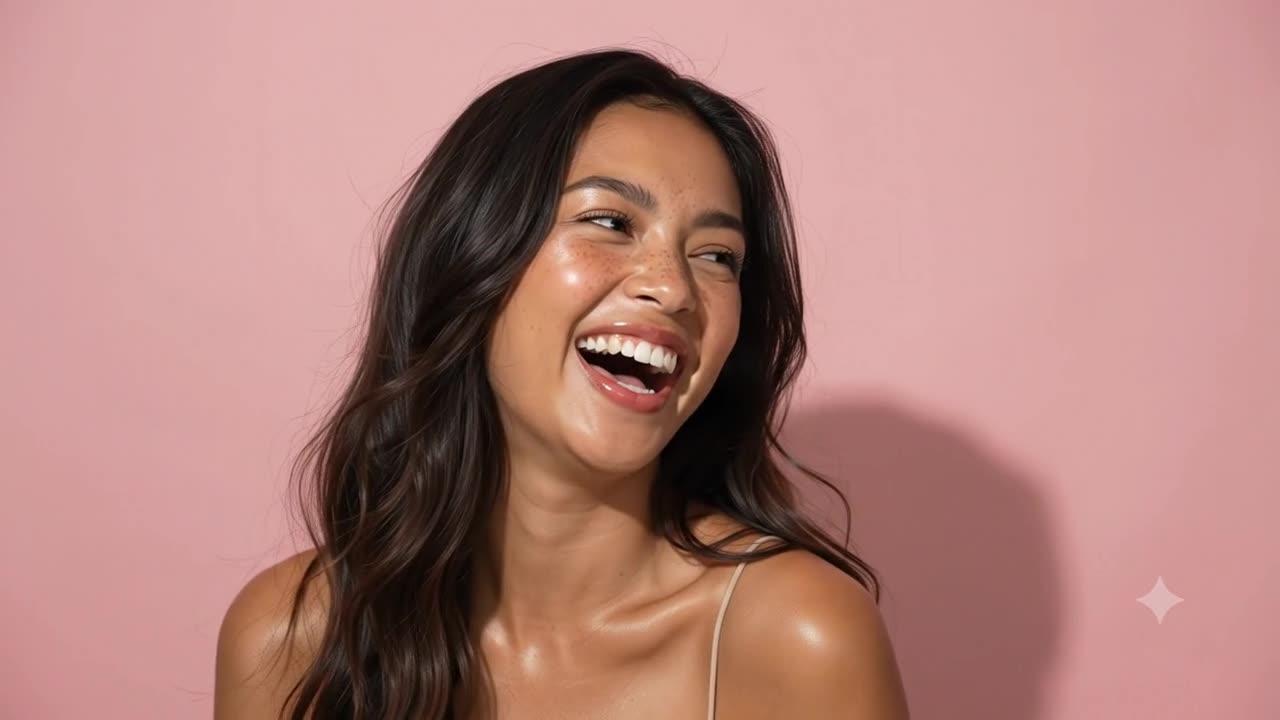
An extension of the AI portrait case study rather than a standalone piece. This page is the prompts themselves, kept separate so the write-up is not buried under 1500 words of prompt text.
These are the two prompts behind my AI portrait test, written out in full. Copy them, change them, break them. No signup, no email, no comment gate.
If you want the reasoning behind any of it, the main write-up explains what each section is doing and why.
Prompt one: beauty portrait
This is the version after six rounds of edits. Generated with free Gemini and ChatGPT Plus.
Beauty campaign portrait photograph of a 21-year-old morena Filipina model,
waist-up, shot on a 100mm macro lens.

EXPRESSION: caught mid-laugh, genuine and unposed. Mouth wide open, upper
teeth exposed with the gum line visible, lower jaw dropped. A Duchenne smile:
orbicularis oculi engaged, lower lids pushed up into crescents, crow's feet
radiating from the outer corners. Eyes narrowed, gaze up and off camera to the
left. Nasal root lightly wrinkled. Cheeks pushed high. Head tilted slightly
back, chin lifted. The smile pulls higher on one side.

SKIN: warm golden-brown morena complexion, professionally retouched but not
plastic. Pore structure retained and visible on the nose and inner cheeks,
finer at the temples, distribution uneven rather than uniform. Fine vellus hair
along the jaw catching the light. Freckles across the nose bridge sitting in
the skin as pigment rather than dots on the surface, denser on one side. Skin
texture continuing down the neck and chest rather than stopping at the jaw.
Subsurface scattering through the ear rim and nostril. Skin looks like real
skin that has been lit and retouched well, not smoothed into plastic.

MAKEUP: dewy skin finish with cream highlighter on the cheekbones, brow bone
and down the nose bridge. Soft cream blush on the apples of the cheeks blending
into the temples. Brows brushed upward with individual hairs visible and gel
holding them, gaps visible between hairs. Mascara on the upper lashes, clumping
in small natural groups, lower lashes bare.

LIPS: high-shine lip gloss in a warm coral red. Specular highlight following
the curve of the lower lip, gloss pooling thicker at the centre and thinning
toward the corners. Gloss catching the light unevenly rather than as one smooth
band. Vermilion border soft, not drawn. Slight gloss transfer onto the upper
teeth edge.

TEETH: natural ivory with enamel translucency at the biting edges. The two
central incisors are visibly different in width, one lateral incisor slightly
rotated, biting edges unevenly worn, one tooth marginally darker than its
neighbours. Whitened for camera but not uniform, and not a repeating shape.

EYES: low crease to monolid with epicanthic fold. Iris warm dark brown with
radial fibre structure, gradient from the limbal ring inward. Sclera faintly
warm, moisture at the inner corner. Catchlights differ between the two eyes
because the head is turned: the near eye shows the rectangular edge of a large
softbox above the lens, the far eye's highlight is smaller and sits closer to
the iris edge. Lower lash line uneven in density along its length.

LIGHTING: clamshell beauty lighting, large softbox above and slightly in front
of the face, a white reflector below filling the under-chin shadow. A small
butterfly shadow directly under the nose. Gentle falloff toward the jaw and
neck. Warm, clean, high-key.

BACKGROUND: seamless studio paper in soft blush pink, lit separately with a
visible gradient falloff from brighter behind the head to darker at the edges.
A soft-edged shadow falls onto the paper behind and below her right shoulder,
darker where she sits closest to it. Faint paper texture visible.

CAMERA: 100mm macro, shallow depth of field with the focal plane on the near
eye. Individual hair strands stay sharp and separated against the background
rather than blending or smearing into it, including the loose pieces falling
across the shoulder. Slight vignetting at the frame corners, faint chromatic
aberration at high-contrast edges, fine sensor grain in the shadows.

FINAL: face visibly asymmetric, one eye squeezing further shut, the mouth
higher on one side. A real editorial beauty photograph of a real model, not a
render, not a 3D character.

Aspect ratio 4:5, maximum resolution.
Prompt two: hand and nails
Written from scratch for a different style of portrait, to find out whether the same approach held up on something unrelated. This is the version with the shadow line in it.
Beauty campaign portrait photograph of a 25-year-old East Asian woman, cropped
tight from mid-forehead to just below the chin, shot on a 100mm macro lens.

EXPRESSION: quiet and direct, no smile. Lips softly parted, relaxed rather than
pursed. Eyes looking straight down the lens, calm and unguarded, upper lids
resting slightly low. Brows relaxed and level. Face still, caught between
moments rather than posed. Faint natural asymmetry, one eye marginally more
open than the other.

POSE AND HAND: one hand raised to the face, fingertips resting lightly against
the lower lip and chin, knuckles gently curved, not gripping. Fingers slightly
separated with natural spacing. Visible knuckle creases, faint tendon
definition on the back of the hand, thin skin over the joints. Nail beds and
cuticles visible, cuticle line slightly uneven.

NAILS: long almond-shaped nails, each painted a different shade of pink. Pale
baby pink, dusty rose, hot fuchsia, soft coral pink, deep magenta. Glossy
finish with a specular highlight running along the curve of each nail,
highlight position varying with the angle of each finger. Slight thickness
visible at the free edge of the nail.

HAIR: black hair pulled back loosely and messily, with strands escaping around
the face. Fine wispy pieces falling across the forehead and cheek, individual
strands separated and sharp, some crossing each other. Baby hairs at the
temples going in irregular directions. Hair slightly damp-looking at the roots
with visible strand definition rather than a solid mass. A few strands lifting
away from the head and catching the light.

SKIN: fair to light warm-toned complexion, dewy and freshly moisturised. Pore
structure visible on the nose and inner cheeks, finer at the temples,
distribution uneven. Fine vellus hair along the jaw and upper lip catching the
light. Subsurface scattering through the nostril and the rim of the ear. Faint
natural texture and unevenness across the cheeks, not smoothed flat. Skin
texture continuing down the neck rather than stopping at the jaw.

MAKEUP: soft rosy blush placed high across the cheekbones and extending onto
the nose bridge, blended with visible gradient edges rather than a hard
boundary. Dewy skin finish with highlighter on the cheekbones, brow bone and
nose bridge. Brows brushed upward with individual hairs visible and gaps
between them. Minimal eye makeup, a soft rose wash on the lids, no heavy liner.
Lashes natural with light mascara, clumping in small groups, sparser on the
lower lid.

LIPS: soft mauve-pink tint with a glossy centre and a more matte outer edge, as
if blotted. Vermilion border soft and undefined. Fine vertical lip lines
visible. Slight natural colour variation, deeper at the corners.

EYES: monolid to low double crease. Iris warm dark brown with visible radial
fibre structure and crypts, gradient from the limbal ring toward the pupil.
Sclera faintly warm rather than pure white, fine vessels near the corners,
moisture at the inner corner. Catchlights differ between the two eyes: the near
eye shows the rectangular edge of the softbox, the far eye's highlight smaller
and closer to the iris edge.

LIGHTING: a single large soft key light positioned frontally, above and
slightly in front of the lens. Small shadow directly under the nose, soft
shadow beneath the raised hand and where the fingers meet the chin. Gentle
falloff toward the jaw and neck. Neutral white balance, bright and airy. The
lighting on the face is consistent with one frontal source and nothing else.

BACKGROUND: plain off-white studio wall. A soft cast shadow falls onto the wall
directly behind her and slightly to the left, thrown by the same frontal key
light above the lens. The shadow shows the silhouette of her head and shoulder
with a soft but readable edge, densest close to her body and fading with
distance. No shadow appears anywhere the key light does not explain. Faint wall
texture visible.

CAMERA: 100mm macro, shallow depth of field with the focal plane on the eyes.
Loose hair strands stay sharp and separated against the background rather than
smearing into it. Slight vignetting at the corners, faint chromatic aberration
at high-contrast edges, fine sensor grain in the shadows.

FINAL: face visibly asymmetric, hand anatomy correct with five fingers, natural
joint proportions and no fused or duplicated digits. A real editorial beauty
photograph of a real person, not a render, not a 3D character.

Aspect ratio 16:9, maximum resolution.
The camera variation
To test how much the camera section was doing, I ran prompt two twice in Gemini and swapped only this block. Everything else stayed identical.
Replace the CAMERA section with this to get the phone version:
CAMERA: shot on an iPhone 14 main camera, 26mm equivalent wide lens held close
to the subject. Deep depth of field, so the hair strands and the background
wall stay reasonably sharp rather than falling away into blur. Mild wide-angle
perspective, with the hand slightly larger relative to the face because it is
closer to the lens. Computational HDR look with lifted shadows and controlled
highlights. Slight over-sharpening at high-contrast edges, faint luminance
noise in the shadow areas, subtle lens flare risk near the brightest part of
the frame. Smartphone colour science, a little warm and contrasty.
One note if you use this: don't leave a 100mm macro instruction anywhere else in the prompt. A phone doesn't have one, and asking for both produces a muddle.
The single most useful line
If you only take one thing from either prompt, take this:
No shadow appears anywhere the key light does not explain.It doesn't remove shadows. It tells the model where a shadow is allowed to sit. It adds no description at all, and it changed my results more than any texture instruction I wrote.
Vocabulary bank
Specific anatomical nouns beat intensity adjectives every time. "Highly detailed skin" gives the model almost nothing to work with. Naming an actual structure gives it a lot, because that phrase appears in captioned reference images.
Skin
pores dilated across the nose and inner cheeks, finer at the temples · pore density uneven, not tiled or repeating · sebaceous filaments visible inside the pores (the tiny grey plugs people mistake for blackheads) · open comedones on the nasal alae · fine vellus hair along the jaw and upper lip, visible where backlit · post-inflammatory hyperpigmentation (the dark marks acne leaves behind) · milia near the eye · subsurface scattering through the ear rim and nostril · freckles sitting in the skin as pigment rather than dots on the surface
Oiliness
specular sheen on the forehead and nose bridge · broken highlight rather than a continuous glossy sheet · matte at the outer cheeks, shiny at the centre · sheen on raised planes: brow bone, nose tip, cheekbone, chin · highlights broken up by skin texture and following the pores rather than sitting on top
Eyes
limbal ring (dark outer edge of the iris) · iris crypts and radial fibres · medial canthus (inner corner) · lacrimal caruncle (the pink bump at the inner corner) · tear film · waterline · epicanthic fold · monolid, low crease, double lid · sclera faintly warm rather than pure white, fine vessels near the corners · a single irregular catchlight broken by the tear film rather than a clean circle
Eyebrows and lashes
individual hairs with visible direction changes · growing upward at the head of the brow, flattening toward the tail · a few strays outside the shape · density uneven between left and right · lashes clumping in small groups rather than evenly spaced · a few crossed lashes · sparser on the lower lid · lash shadow falling on the sclera
Teeth, gums and lips
vermilion border (the lip edge) · Cupid's bow · philtrum · gingival margin (where gum meets tooth) · interdental papillae (the gum triangles between teeth) · incisal edge · enamel translucency at the incisal third · central incisors not matched in width · one lateral incisor slightly rotated · natural ivory rather than bright white · fine vertical lip lines · soft transition at the vermilion border rather than a drawn line
Nose
nasal bridge · dorsum · nasal tip · alae (the wings) · alar crease · columella (the strip between the nostrils) · nostrils slightly different in size · alar crease deeper on one side
Hair
terminal hairs (thick and pigmented) · vellus hairs (fine and pale) · baby hairs at the temples · flyaways · strand definition · scalp visible at the parting · individual strands defined at the hairline rather than rendered as a solid mass · strands staying sharp against the background rather than smearing into it
Expression
Duchenne smile (orbicularis oculi engaged, not just the mouth) · zygomaticus major pulling the corners up and back · levator labii superioris raising the upper lip · malar fat pads pushed high · procerus and nasalis wrinkling the nasal root · lower lids pushed up into crescents · crow's feet radiating from the lateral canthi · caught mid-sound rather than held for the camera
Lighting
soft window light from camera left · large diffused source · clamshell beauty lighting · short lighting · butterfly shadow under the nose · falloff into shadow at the neck · light raking across the skin at a low angle so pores and vellus hair cast their own micro-shadows
Camera
85mm portrait lens · 100mm macro · shallow depth of field with the focal plane on the near eye · slight vignetting at the corners · faint chromatic aberration at high-contrast edges · fine sensor grain in the shadows · neutral colour science · no beauty retouching, no skin smoothing
Asymmetry
The one most people skip, and the one that matters most. Real faces are visibly uneven and models default to mirroring.
face visibly asymmetric · one eye squeezing further shut than the other · the mouth pulling higher on one side · nostrils slightly different in size · brow density uneven between left and right · blemishes clustered more heavily on one side · the nose not centred on the facial midline
Checking your output
Zoom to 100% and look at these in order, because this is roughly the order things fail in.
- Teeth. Count them. Check the two central incisors are different widths.
- Catchlights. Both eyes, same shape, same position relative to the pupil?
- Hair against the background. Any halo or smearing at high-contrast edges?
- Pore field. Does the texture repeat or tile anywhere?
- Symmetry. Cover one half of the face, then the other. Do they match too well?
- Hands, if there are any. Finger count, joint spacing, whether the thumb reads as a thumb.
- The shadow. Does it agree with where the light is on the face?
Keep the failures. They are more useful than the successes, and they are better content.
Back to the full write-up for what each section is actually doing and why.